
Stanford’s Hacking for Defense Program Connects With California Army National Guard
H4D program can help address some of the Guard’s most pressing challenges


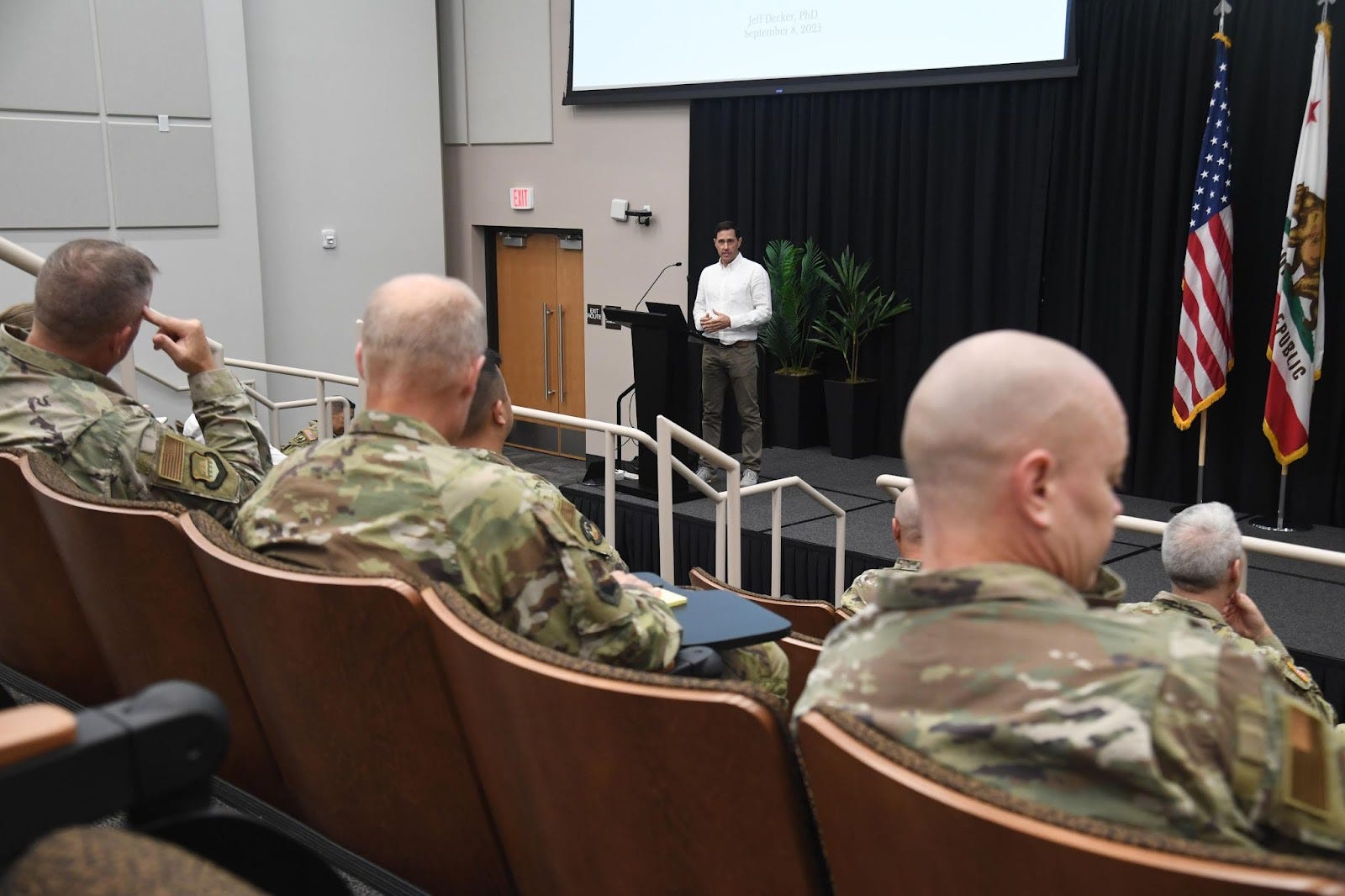
Recently, I had the opportunity to meet with the California Army National Guard in Sacramento to share how Stanford University’s Hacking for Defense® (H4D) program can help address some of the Guard’s most pressing challenges.
Since its launch in 2016 at Stanford, H4D has expanded to more than 70 colleges and universities across the country. The course brings interdisciplinary student teams together with government sponsors to explore real-world mission problems. Using the Lean LaunchPad methodology, students spend weeks interviewing stakeholders, testing assumptions and iterating toward solutions and a MVP that can make an immediate impact.
The California Army National Guard is uniquely positioned at the crossroads of federal defense missions and state emergency response. That dual role creates opportunities for H4D students to work on problems that matter both locally and nationally — from wildfire response and disaster recovery to logistics, cybersecurity and interagency coordination.
Engaging with the National Guard with H4D brings additional real-world problems for the class to solve. With H4D, we encourage military divisions and national security departments to submit challenges that are unclassified, operationally relevant and supported by a “problem champion” who can meet regularly with student teams and help provide access to potential stakeholders and decision makers. These champions provide access to those on the ground, doing the work, and include warfighters, support staff, leaders and partners who bring the issues into sharper focus for our students.
The results of the course speak for themselves. In the past decade, H4D has helped launch 72 startups, raised more than $350 million in funding and created more than 600 jobs. Some solutions have transitioned directly into government use, while others have grown into dual-use companies serving both military and civilian markets.
Equally important, the program has shaped the next generation of problem-solvers. Surveys show that 92 percent of H4D alumni report that taking the course had an immediate impact on their career plans, and more than three-quarters say the experience reshapes their long-term vision of public service.
National security challenges are evolving quickly. By working with programs like H4D, the California Army National Guard can surface fresh ideas, reduce risk and inspire future leaders to serve. I look forward to seeing the Guard’s problems submitted and to watching student teams tackle them with urgency and creativity.
For more information about the H4D course at Stanford, visit h4d.stanford.edu. To learn more about the nationwide program, visit h4d.us or commonmission.us.
The Hacking for Defense (H4D) program has been taught at 70 colleges and universities around the world and has created 72 startups that have generated 660 jobs and raised more than $350 million. To learn more about the H4D course at Stanford University visit h4d.stanford.edu; to learn more about H4D around the world visit h4d.us. To learn more about The Hacking for Defense® Manual by Jeff Decker, PhD, visit Amazon.